


A turned-parts supplier in Manesar gets a request for quotation from a buyer in Dubai. The part is a brake-line fitting for a commercial-vehicle programme. The email asks for a Level 3 PPAP, attaches the parent group’s supplier quality manual, and wants samples shipped to a warehouse in Jebel Ali with documents in English. The forms are the ones the plant already fills for customers in Pune and Chennai. What is new is the layer above them: whose checklist applies, which UAE and Gulf rules touch the part, and what the importer will ask for at the border.
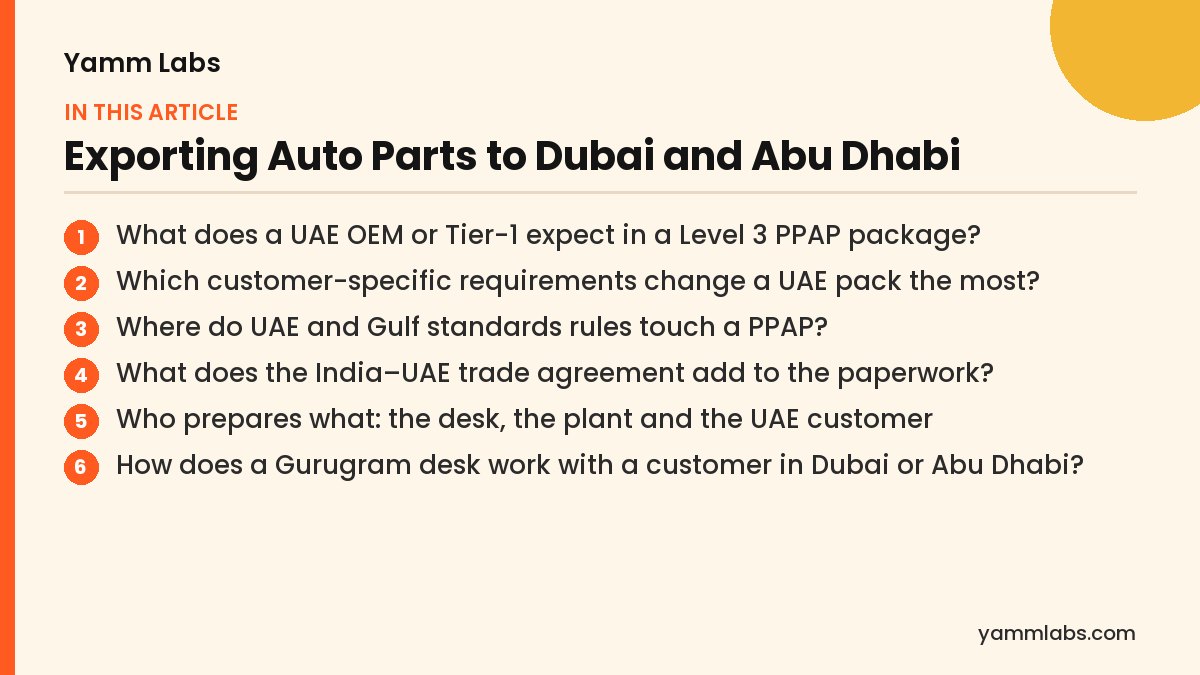
- What does a UAE OEM or Tier-1 expect in a Level 3 PPAP package?
- Which customer-specific requirements change a UAE pack the most?
- Where do UAE and Gulf standards rules touch a PPAP?
- What does the India–UAE trade agreement add to the paperwork?
- Who prepares what: the desk, the plant and the UAE customer
- How does a Gurugram desk work with a customer in Dubai or Abu Dhabi?
- People also ask
What does a UAE OEM or Tier-1 expect in a Level 3 PPAP package?
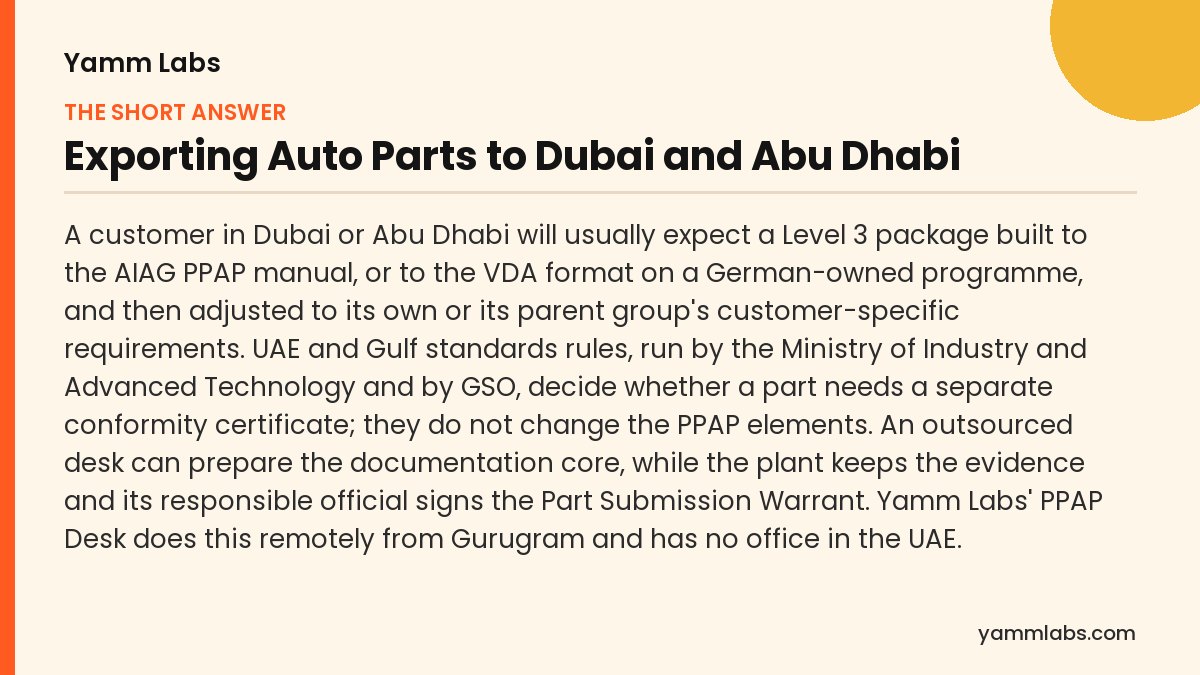
The base document is the same one an Indian customer uses. The AIAG PPAP manual defines how a supplier shows that its production process can make parts to the design record at the quoted rate. It sets out five submission levels. Level 3 is the default unless the customer specifies another, and it means the warrant goes in with product samples and complete supporting data.
The UAE buyer is the part that changes. A customer in Dubai or Abu Dhabi can be a regional arm of a global vehicle group, a bus, truck or trailer body builder, a specialist vehicle maker, or a trading company buying for a programme assembled elsewhere. Each one points back to someone else’s rulebook. A regional arm follows its parent’s customer-specific requirements. A body builder follows the chassis maker’s. A trading company passes on the end customer’s. So the first question on any UAE enquiry is not which forms to fill, but whose checklist the pack will be judged against.
The table lists the bodies whose rules shape a UAE-bound pack, what each governs, and the documentation decision each forces.
| Body or rule source | What it governs | Documentation decision it forces |
|---|---|---|
| AIAG PPAP manual | Submission levels, the list of elements, the Part Submission Warrant, full and interim approval | Default to Level 3 unless told otherwise; draft the warrant last, from the finished pack, and leave the signature to the plant’s responsible official |
| OEM customer-specific requirements, published through IATF Global Oversight | Each vehicle group’s additions to the manual’s generic requirements | Ask in writing, at the quoting stage, which group’s CSR applies, then build the pack to that checklist rather than to the manual’s generic list |
| VDA, for German-owned programmes | The German sampling and product approval format used by German OEMs and many of their suppliers | Confirm whether the buyer wants AIAG PPAP, the VDA format or both, because the two packs are not interchangeable |
| Ministry of Industry and Advanced Technology, UAE | UAE standards, certificates of conformity with technical requirements, registration of conformity assessment bodies, national accreditation and product recalls | Add a market-conformity line to the package index: does a UAE technical regulation cover this part, who holds the certificate, and which accredited laboratory’s report will be accepted |
| GSO, the GCC Standardization Organization | Unified standards, conformity assessment and metrology across the Gulf states, including the UAE | Check the drawing’s material and test specifications against any Gulf standard the buyer names, so one test plan serves the UAE and the buyer’s other Gulf markets |
| India–UAE Comprehensive Economic Partnership Agreement | Preferential trade between the two countries, subject to its rules of origin | Keep the tariff classification, the origin paperwork and a supporting bill of material in the same folder as the warrant |
One clarification saves a wasted meeting. The UAE’s financial regulators oversee banks, insurers and financial markets. None of them governs a part approval. If a UAE compliance checklist lands on your desk with a financial regulator’s name on it, it belongs to the buyer’s finance team, not to your PPAP.
Which customer-specific requirements change a UAE pack the most?
The requirement that moves the pack most is the parent group’s CSR. IATF Global Oversight publishes the current CSR documents for Ford, General Motors, Stellantis, BMW Group, Mercedes-Benz Group, Volkswagen, Renault Group, Geely, Volvo Group and IVECO Group. As of September 2026 the page shows a Renault Group CSR dated April 2026, a Geely CSR dated June 2025, a Volvo Group CSR dated 28 February 2025 and an IVECO Group CSR dated 24 November 2025, with BYD and Jaguar Land Rover listed as under development.
Many vehicle groups active in the Gulf are not on that list, and their supplier manuals come directly from the buyer. That is the regulator-driven decision on a UAE order. Before a single form is drafted, the desk asks the buyer to name, in writing, the governing CSR or supplier manual, its revision, the approval format and the submission level. A pack built to the wrong revision fails at the buyer’s desk even when every page is correct.
The CSR then changes the pack in ways the manual’s generic list does not cover, from what goes into the pack to how it is submitted and what is expected of the supplier’s own sub-suppliers, such as a plating or heat-treatment vendor. Read it line by line and check each requirement against the plant’s own practice. The PPAP documentation FAQ covers the AIAG and VDA question in more detail.
Where do UAE and Gulf standards rules touch a PPAP?
They touch it at the edges, not in the middle. The Ministry of Industry and Advanced Technology was set up in July 2020 and took in the Emirates Authority for Standardization and Metrology, ESMA. It now runs the UAE’s standards services, issues certificates of conformity with technical requirements, registers and designates conformity assessment bodies, and runs the Emirates National Accreditation System. GSO, which started operating in May 2004, unifies standards and conformity work across its member states, the UAE among them.
A PPAP proves your process makes the part to the customer’s drawing. A UAE certificate of conformity proves a product meets a UAE technical requirement. They are different documents, usually held by different parties, and the second is often the importer’s job. The design decisions follow from that split.
- Decide conformity before the lab booking. If a UAE or Gulf technical regulation covers the part, ask the buyer which test reports and which accredited laboratories it will accept. Book the tests in India once, to a plan that satisfies both the PPAP and the certificate, rather than twice.
- Put traceability into the control plan, not the covering letter. The Ministry also runs Manaa, a product recall management system with a central database of recalled products. A buyer that may have to pull a batch off UAE shelves will want lot number, date code and heat or batch number carried through the process flow, the control plan and the label.
- Keep the market-conformity line in the package index. One line that says whether a UAE regulation applies, and who holds the certificate, answers the question a buyer’s auditor asks first.
The manual is the floor, the parent group’s CSR is the test, and the UAE certificate is a separate exam.
What does the India–UAE trade agreement add to the paperwork?
It adds origin paperwork that travels with the part. India and the UAE signed a Comprehensive Economic Partnership Agreement in 2022. Whether a given part gets preferential treatment depends on the agreement’s rules of origin, and the claim has to be backed by origin documentation from the Indian side. The PPAP does not decide any of this, but the same folder should hold three items: the tariff classification, the origin documentation and a bill of material that supports both. When a buyer’s quality team and its customs broker ask for documents in the same week, one folder answers both. The auto-component boom article explains why paperwork lead time, not machining lead time, is what slows Indian exporters down.
Who prepares what: the desk, the plant and the UAE customer
Split the work by who holds the information. Documents that can be authored from the drawing, the route and the customer’s requirements can be prepared by an outsourced desk. Evidence that only exists after parts are made stays in the plant. Approval stays with the customer. This is how Yamm Labs’ PPAP Desk works on any order, domestic or export.
- The desk prepares the documentation core. From the drawing and the process data, the desk builds the ballooned print with a characteristic register, the process flow diagram, the PFMEA, the control plan, process and setup sheets, the checking-aid list, the incoming inspection standard, MSA and dimensional report formats and capability study formats, then drafts the warrant and the package index. On a UAE order it works to the CSR or supplier manual the plant supplies.
- The plant keeps the evidence. The trial run, physical measurements, capability studies, Gage R&R trials, laboratory testing, samples, master sample and IMDS entry are done in the plant. The desk formats the results; it does not produce them.
- The plant’s checker verifies every document. Nothing goes to the buyer until a person in the plant who knows the part has read each page against the drawing and the customer’s checklist.
- The responsible official signs the PSW. The Part Submission Warrant is the supplier’s warranty to the customer. A consultant, desk or agency cannot sign it.
- The UAE customer approves or rejects. Full approval, interim approval or rejection is the customer’s call under its own requirements.
This also answers the question a UAE buyer’s auditor may ask directly: who wrote your PPAP? The plant owns it and signed it, and a documentation desk drafted the paperwork under the plant’s control, as an external provider the plant evaluates and verifies. The PPAP Desk service page describes it from the desk’s side.
How does a Gurugram desk work with a customer in Dubai or Abu Dhabi?
Remotely, and with an easy clock. Yamm Labs works from a single office in Gurugram and serves clients across India and the Gulf, with international clients, running international work remotely with calls and reviews scheduled across time zones. It has no office, licence or client in the UAE that it can name, and this page claims none.
The time difference shapes the timeline. The UAE runs on UTC+4 and India on UTC+5:30, so a buyer in Dubai or Abu Dhabi is one and a half hours behind Gurugram, and the working days overlap almost completely. That allows a same-day review loop: the desk sends a draft in the Indian morning, the buyer’s quality engineer comments before the UAE day ends, and the fix goes out the next morning.
On the five-day pilot the sequence is fixed. Day 0 the NDA is signed and the plant sends the inputs, including the released drawing, the route, the gauge list and the buyer’s CSR. Day 1 the route is confirmed. Days 2 to 4 the desk builds and QA-checks the pack. Day 5 the checker-ready pack goes to the plant, which then runs its trial, measurements and signature on its own timeline.
Budget follows the same logic. The PPAP Desk two-part pilot is free, with no retainer and no software setup, so the pilot is a low-risk test. The only proof the desk cites is its own: more than fifty Level 3 PPAP reports generated for Manu Auto India, an Indian client. No UAE client is claimed. Where the agency is based and how it works is on the About page.
People also ask
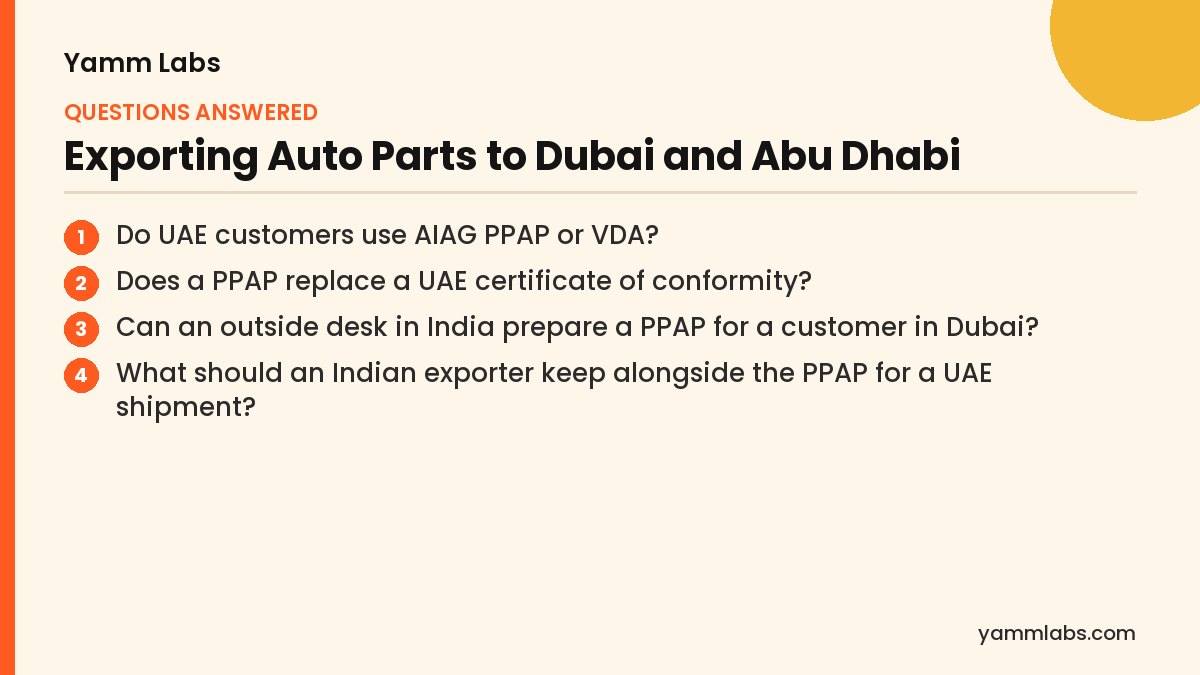
Do UAE customers use AIAG PPAP or VDA?
It depends on whose programme the part serves. Groups that follow AIAG, such as Ford, General Motors and Stellantis, expect AIAG PPAP, while German-owned programmes may ask for the VDA format instead or as well. Ask the buyer to confirm the format and the governing CSR in writing before the pilot starts.
Does a PPAP replace a UAE certificate of conformity?
No. A PPAP shows your process makes the part to the customer’s drawing, while a certificate of conformity from the Ministry of Industry and Advanced Technology shows a product meets a UAE technical requirement. If a regulation covers the part, plan the tests so one set of reports serves both.
Can an outside desk in India prepare a PPAP for a customer in Dubai?
Yes, provided the plant owns it. The desk drafts the documentation core, the plant’s checker verifies every page, and the plant’s responsible official signs the warrant. The desk works as an external provider the plant controls.
What should an Indian exporter keep alongside the PPAP for a UAE shipment?
Keep the tariff classification, the origin documentation and a supporting bill of material in the same folder as the warrant. The importer of record will need them to claim treatment under the India–UAE trade agreement. Add a line to the package index saying whether a UAE conformity certificate applies and who holds it.
Sources
- inspectionxpert.com: Five levels, Level 3 = PSW with samples and complete supporting data, default when customer does not specify (
- IATF: Customer Specific Requirements
- keytodata.com: PPF/PPA follows German VDA Volume 2, PPAP follows AIAG
- moiat.gov.ae: Established July 2020
- moiat.gov.ae: Manaa is a product recall management system with a central database of recalled products
- gso.org.sa: Began operating May 2004
Quoting your first Level 3 for a buyer in Dubai or Abu Dhabi and unsure whose checklist applies?
Prove it on two live parts: a five-day pilot inside your existing quality process. No retainer, no software setup. Start a 2-part pilot →
One Comment