

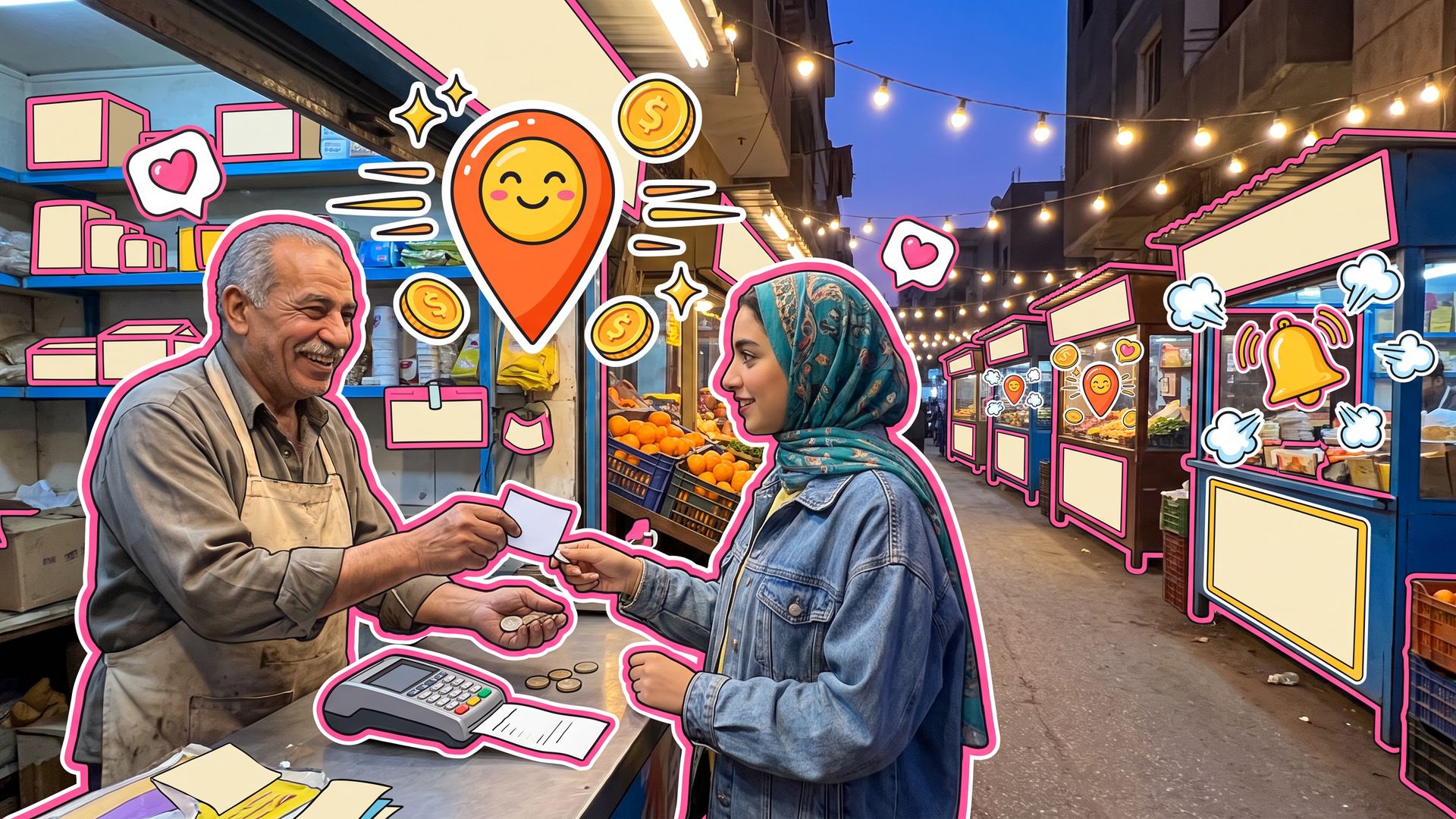
A man walks into a small grocery in a Cairo side street with a folded electricity bill and a few notes of cash. He does not open an app. He does not own a card. The shopkeeper takes the bill, taps a number into a terminal by the till, takes the cash and prints a slip.
The only brand in the whole exchange is the sign on the terminal, and the man trusts it because he has seen the same sign at the pharmacy, the mobile shop and the kiosk near the bus stop. That is the Fawry brand history in one scene. It did not win Egypt with a famous commercial. It won by being the name on the counter wherever cash changed hands.
- What was Fawry’s brand strategy, if not advertising?
- Fawry brand history: from bill payment to a listed fintech
- Why being everywhere worked in a cash-heavy market
- Where does a ubiquity brand stop working?
- What should an Indian regulated brand take from Fawry?
- How do you build ubiquity without losing control of the brand?
- People also ask
What was Fawry’s brand strategy, if not advertising?
The campaign was the network. Most brand histories start with a launch film and an agency. Fawry’s starts with a problem. In 2008 Fawry launched an electronic payment gateway that let people without a bank account or a credit card pay bills online, at ATMs and at dedicated service points. The product was infrastructure. The brand was the promise that the infrastructure would be close to you.
That promise had to be kept in physical space before it could be said in media. A payment brand in a cash-heavy market is judged at the counter: is the sign there, does the shopkeeper know the steps, does a slip come out, did the money arrive. Co-founder Mohamed Okasha told Wamda in 2019 that in the early years people paid their bills through Fawry and then called the call centre to check whether the payment had gone through. That single detail explains the whole strategy. Trust was earned transaction by transaction, and repetition across thousands of counters did the work that a slogan could not.
Ad listings credit individual Fawry campaigns to agencies; Ads of the World, for example, credits a 2018 FawryPay campaign to the Cairo agency ARQQA. But no single campaign explains the brand. What the record does show is a company that treated reach as its message and let the network carry the name.
SIGNALNewsletter by Yamm Labs
The next piece, straight to your inbox.
New writing on BFSI brands, B2B and influencer marketing, and AI search.
One click to unsubscribe. Privacy policy

Fawry brand history: from bill payment to a listed fintech
Every date and number below comes from a published source we opened. Where two sources disagree, we say so.
| When | What happened | What it did for the brand |
|---|---|---|
| 2008 | Fawry founded by Ashraf Sabry and Mohamed Okasha as an electronic payment gateway for bills, usable without a bank account. One later report gives 2009; most sources say 2008. | Positioned the name as the way to pay, not as a bank. |
| 2011 to 2013 | After the 2011 revolution, the founders kept investing for two to three years while the market looked risky. The IFC took an 18 percent stake at the start of 2013. | Kept the network growing while others pulled back. |
| January 2015 | Fawry soft-launched an online car licence renewal platform with the government, with an advertising campaign planned for the following month, alongside national electricity bill payment. | Moved the brand from private bills into state services. |
| November 2015 | A consortium of the Egyptian-American Enterprise Fund, Helios Investment Partners and the MENA Long-Term Value Fund bought an 85 percent stake for $100 million. Fawry then reported more than 1.3 million transactions a day through 50,000 distributors in more than 300 cities and districts. | Funded the next stage of reach. |
| 2017 | A presidential decree set up Egypt’s National Payments Council, with the stated aim of reducing cash use outside the banking sector. | Put policy behind the category Fawry had built. |
| April 2019 | Fawry reported 20 million customers and more than 2 million transactions a day, and had launched FawryPay, a gateway for online merchants. | Extended the counter promise to e-commerce checkout. |
| August 2019 | Listed on the Egyptian Exchange. Shares priced at EGP 6.46 closed the first day at EGP 8.48; the public offering was oversubscribed 30 times. The network then counted more than 100,000 service points across 300 cities. | Made the brand a household stock as well as a household counter. |
| August 2020 | Reported as the first Egyptian startup to reach a $1 billion market value, within a year of listing. | Became the reference name for Egyptian fintech. |
| January 2022 | Announced an EGP 800 million rights issue to fund consumer and merchant financial services and position myFawry as a super app. | Began the shift from counter brand to app brand. |
| August 2023 | Announced plans to turn myFawry into a digital bank; app downloads reached 10.5 million in the first half of 2023. | Took the brand into regulated banking territory. |
| March 2025 | Partnered with Contact Financial Holding to offer buy now, pay later across a network of more than 370,000 points of sale. | Put credit on the same counter as bill payment. |
Why being everywhere worked in a cash-heavy market
In a market where most people pay in cash, the brand that wins is the one people can reach on foot. Its record points to four lessons.
- Reach is the proof. A customer who sees the same sign at six shops on one street reads that as scale, and scale reads as safety. No claim in an advertisement does that as well.
- The shopkeeper is the brand ambassador. The agent at the counter explains the product, handles the cash and hands over the slip. If the agent is confident, the brand is trusted. If the agent fumbles, the brand takes the blame.
- The slip is the most important brand asset. For a cash customer, a printed receipt with the brand name and a reference number is the only evidence the money moved. In the early years customers still called to check. A clear receipt closes that gap.
- Government services turn a habit into a necessity. Once car licence renewals and electricity bills could be paid through the same brand, it stopped being optional. People came for one service and learned the others.
Covid-19 then pushed demand for digital payments up. Wamda reported in August 2020 that Fawry’s share price had risen more than 300 percent since the listing. The network was already in place when the market needed it.
Where does a ubiquity brand stop working?
Ubiquity has limits, and Fawry’s own later moves show where they sit.
The first limit is the move from counter to phone. A counter brand is built by agents; an app brand is built by the product itself. Fawry’s plan to turn myFawry into a super app and then a digital bank asks the same name to mean something new. The app reached 10.5 million downloads in the first half of 2023, which is large, but the app has to earn trust without a shopkeeper standing next to the customer.
The second limit is credit. Paying a bill is simple: money in, slip out. Lending is not. When buy now, pay later appears on the same counter, the brand has to carry interest, instalments, fees and consequences. A payment brand that means convenient and quick now also has to mean clear and fair, and those words need different design.
The third limit is the rulebook. Egypt’s central bank describes its payment oversight as covering payment service providers and their agents, and its consumer protection work as making sure licensed entities treat customers in a fair, professional and transparent way. In 2023 the central bank issued rules for licensing digital banks, and the Financial Regulatory Authority issued rules for fintech in non-bank financial services. The further the brand moves into regulated products, the more each counter becomes a point of regulated communication.
In a cash market, the counter is the campaign, and every counter has to say the same thing.
What should an Indian regulated brand take from Fawry?
India has UPI, so the cash counter problem looks different. But many financial products are still sold through assisted channels: bank correspondents, insurance intermediaries, mutual fund distributors, loan agents and merchant partners. The Fawry lesson applies directly to them. If you want to be everywhere, you have to decide in advance what every counter, poster and screen may say, because in India the regulators decide much of it for you.
These are the design decisions we would build into a ubiquity plan for an Indian regulated brand, each driven by a specific rule:
- Lock the partner lockup for insurance. Under IRDAI’s 2024 policyholder protection regulations, every insurer’s advertisement must show the insurer’s registered name with its trade name or logo prominently, and advertisements issued by distribution channels need the insurer’s written approval before they go out. So the partner kit ships as pre-approved templates, with the insurer’s registered name locked into the layout and a single fixed slot for the partner’s shop name. Partners do not design their own posters.
- Put the Key Facts Statement before the confirm button. RBI requires lenders to give borrowers a Key Facts Statement, including the annual percentage rate, before the loan contract is executed, for retail and MSME term loans sanctioned from 1 October 2024. On a counter tablet or in an app, the screen sequence is fixed: product, amount, Key Facts Statement with the APR, acknowledgement, then confirm. The KFS never comes after the signature screen.
- Budget video spots for the mutual fund warning. SEBI’s advertisement code requires the standard mutual fund warning in audio-visual advertisements to be both displayed and voiced over clearly enough to be understood, which takes several seconds of airtime. In a ten-second spot, that is a large share of the time. For a mass-reach mutual fund campaign on screens at partner outlets, plan fifteen or twenty seconds, or use static creative where the warning sits in a fixed band.
- Design the receipt as a brand asset. Whatever the product, the slip or confirmation screen should carry the regulated entity’s name, a reference number and a support route. It is what the customer keeps.
For a wider view of how payment and trading brands handle these choices, see our 100 questions on trading and payment app branding. For the principles behind a regulated brand that people trust, read what makes a great BFSI brand.
How do you build ubiquity without losing control of the brand?
Ubiquity without control turns into noise. Thousands of partners with their own versions of the logo, their own claims and their own handwritten rate cards will undo a brand faster than any competitor. Fawry’s model worked because the terminal, the process and the slip were the same everywhere.
For an Indian bank, insurer, AMC or payments company, the practical plan has three parts. First, a partner brand system: one locked lockup, a small set of approved templates, and clear rules for where the partner’s own name may appear. Second, a compliance layer built into the templates rather than checked afterwards: disclaimers in fixed positions, warnings sized to be read, and approval records kept for every partner asset. Third, a feedback loop: regular checks of what is actually on the counters, because what head office approved and what a partner printed are not always the same thing.
Yamm Labs works from Gurugram with BFSI brands in India, the Gulf and elsewhere, remotely. You can read more about how we work.
People also ask
Who founded Fawry and when?
Fawry was founded in 2008 by Ashraf Sabry and Mohamed Okasha. It began as an electronic payment gateway that let Egyptians pay bills without a bank account or credit card, online, at ATMs and at service points.
When did Fawry list on the stock exchange?
Fawry listed on the Egyptian Exchange in August 2019. The shares were priced at EGP 6.46 and closed the first day at EGP 8.48, and the public offering was reported as oversubscribed 30 times.
Which agency created Fawry’s advertising?
Ad listings credit individual campaigns to agencies; Ads of the World, for example, credits a 2018 FawryPay campaign to the Cairo agency ARQQA. The company’s brand was built mainly through its payment network, with advertising supporting specific launches such as its online car licence renewal service in 2015.
Can an Indian financial brand copy Fawry’s ubiquity strategy?
The principle carries over, but the execution must follow Indian rules. Insurance partner advertisements need the insurer’s written approval, retail and MSME loan journeys must show the Key Facts Statement before the contract is executed, and mutual fund video spots must display and voice the standard warning clearly, so the partner kit has to build these in from the start.
How big did Fawry’s network grow?
The published figures show steady growth. Fawry reported 50,000 distributors in more than 300 cities and districts in November 2015, more than 100,000 service points across 300 cities at its August 2019 listing, and a network of more than 370,000 points of sale when it announced its buy now, pay later partnership with Contact Financial Holding in March 2025.
Why does Fawry brand history matter to marketers outside Egypt?
It shows that in assisted, cash-heavy channels, reach and consistency can build trust faster than advertising. The same sign, process and receipt at every counter told customers the brand was safe. Any financial brand that sells through agents, correspondents or merchant partners faces the same question: what does every counter say, and who controls it?
What was the role of the receipt in Fawry’s brand?
For a customer paying in cash, the printed slip with the brand name and a reference number was the only evidence the money had moved. Co-founder Mohamed Okasha described early customers calling the call centre to check whether a payment had gone through. A clear receipt closes that gap, which is why we treat the slip or confirmation screen as a brand asset.
Sources
- Wamda: A conversation with Mohamed Okasha of Fawry (April 2019)
- Wamda: Fawry reaches a $1 billion market capitalisation (August 2020)
- Wamda: Consortium of investors acquires major stake in Fawry for $100m (November 2015)
- Wamda: Egyptian entrepreneurs push forward long-awaited e-government measures (January 2015)
- Central Bank of Egypt: National Payments Council
- Wamda: Fawry lists on the Egyptian Exchange (August 2019)
Planning to put your brand on every counter? Check it first.
Get a free Fintech Brand Audit across 8 dimensions, plus 3 fixes. No pitch. Run the free Brand Audit →