

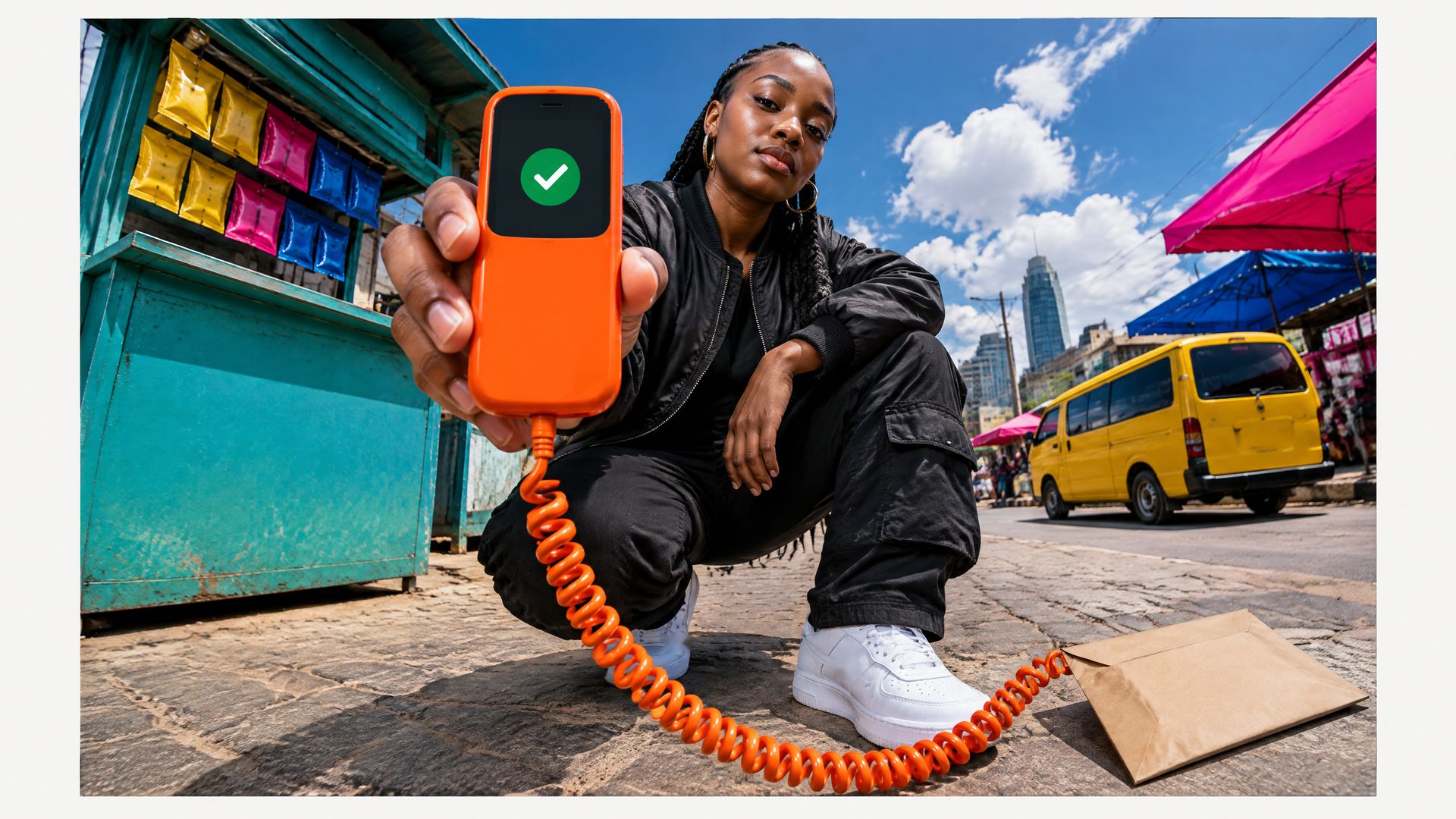
Nairobi, 2006. A builder gets paid on a Friday, folds part of his wages into an envelope and walks to the bus stage. He hands it to a driver heading upcountry and hopes his mother sees the money by Sunday. A year later the same man could hand cash to the shopkeeper who sold him airtime, key in his mother’s number, and read a text message saying the money had arrived. The technology was a SIM menu on a basic phone. The hard part was belief: getting people to accept that money they could not see was still there.
- What did Safaricom launch in 2007, and why was the message “Send Money Home”?
- M-Pesa timeline: what ran, when, and who was behind it (2006 to 2022)
- Which Central Bank of Kenya decisions shaped the M-Pesa brand?
- Why did the agent network become M-Pesa’s real brand?
- Where did M-Pesa’s trust model come under strain?
- What should an Indian bank, NBFC or payments app take from M-Pesa?
- People also ask
What did Safaricom launch in 2007, and why was the message “Send Money Home”?
M-Pesa started as a different product. Vodafone, backed by a grant from the UK’s Department for International Development, set out to build a way for microfinance borrowers to receive and repay loans by phone. The trial ran with Faulu Kenya, a microfinance institution, and about 500 of its customers in Thika and Mathare. Those customers loaded money in Thika, travelled to Nairobi and withdrew it to buy stock. Safaricom’s own history says they were using it as a safety deposit box for carrying cash.
That observation became the launch. Safaricom’s then chief executive, Michael Joseph, backed turning the pilot into a person-to-person transfer service, and Safaricom invested $10 million to fit it to the Kenyan market. The Financial Sector Deepening Kenya trust records that M-Pesa launched in March 2007 focused on money transfer and marketed as “Send Money Home”. The Ministers for ICT and Finance attended the launch, which a case study written with the Central Bank of Kenya for the Alliance for Financial Inclusion describes as a show of support.
The message worked because it named a habit, not a product. The 2006 FinAccess survey, quoted in that case study, found that only 19 percent of Kenyans had a bank account, and that the most common ways to send money inside the country were informal: 58 percent sent it with family or friends and 27 percent through a bus or matatu company. Nobody had to be taught to send money home, only persuaded that a phone company was a safer courier than a bus driver.
The name came from Kenya too. Safaricom’s account says a local advertising agency came up with M-PESA, m for mobile and pesa for money in Swahili. That account does not name the agency, and we do not either.
Adoption outran the plan. The business plan aimed for 300,000 customers in year one. By November 2007 Safaricom counted 1,041,522 active users.
SIGNALNewsletter by Yamm Labs
The next piece, straight to your inbox.
New writing on BFSI brands, B2B and influencer marketing, and AI search.
One click to unsubscribe. Privacy policy

M-Pesa timeline: what ran, when, and who was behind it (2006 to 2022)
Every row comes from an opened primary or official source. Where a source does not name someone, the table says so.
| When | What happened | Who was behind it | What it changed for trust |
|---|---|---|---|
| August 2006 | Safaricom approaches the Central Bank of Kenya about M-Pesa | Safaricom | The regulator is involved before a single customer is signed |
| January 2007 | Central Bank legal opinion finds M-Pesa is not banking business | Central Bank of Kenya | Customer money held in trust, not lent, not paid interest |
| February 2007 | Letter of no objection with conditions on fraud, privacy, laundering and record keeping | Central Bank of Kenya | Launch permitted under supervision before a payments law existed |
| March 2007 | Public launch as “Send Money Home”, attended by the Ministers for ICT and Finance | Safaricom; name from a local advertising agency not named in the source | One use case, one emotional promise |
| September 2008 | Survey of over 3,000 users finds more than 80 percent happy with the service; 4 million customers and 4,230 agents | Commissioned by the Central Bank with FSD Kenya | Evidence the regulator could later show in public |
| December 2008 | The Finance Minister publicly asks the Central Bank to audit M-Pesa | Ministry of Finance | First national test of the trust story |
| January 2009 | The Central Bank issues a public statement; it and the Ministry place a newspaper advertisement explaining the safeguards | Central Bank of Kenya; Ministry of Finance | The regulator vouches for the trust account in print |
| 2011 | National Payment System Act enacted | Parliament of Kenya; Central Bank of Kenya | Mobile money gets a law of its own |
| July 2014 | Competition Authority ruling removes exclusivity from agent contracts after a complaint by Airtel | Competition Authority of Kenya | The agent counter can no longer belong to one brand |
| 1 August 2014 | National Payment System Regulations published, covering trust funds, agents, disclosure and complaints | Central Bank of Kenya | Trust practices become written rules for every provider |
| January 2019 | Fuliza overdraft launches on M-Pesa | Safaricom; NCBA and KCB are the partners named in the 2022 release | M-Pesa moves from holding money to lending it |
| 16 March 2020 | Emergency measures: no charge on transfers up to KSh 1,000 and higher transaction limits | Central Bank of Kenya, after meeting payment providers | The regulator sets the price during a crisis |
| 28 September 2022 | Fuliza restructured with a free daily fee for the first three days on small amounts, and a credit repair plan for digital loan defaulters | Safaricom, NCBA and KCB | Admission that the credit product had drifted from its purpose |
Which Central Bank of Kenya decisions shaped the M-Pesa brand?
In 2007 Kenya had no payments law that covered a phone company moving money. The Central Bank had drafted a National Payment System Bill, but it had not entered Parliament by late 2008. Its counsel concluded in January 2007 that M-Pesa was not banking business: customer cash was not lent out, it sat in a pooled trust account at a bank, and no interest was paid on it. The letter of no objection followed in February 2007, with conditions on fraud, money laundering and record keeping. Each became a brand decision.
- A trust account, not a deposit. Governor Njuguna Ndung’u made a bank a condition of approval: the money collected from customers had to sit in a bank while Safaricom’s platform credited and debited e-money. Commercial Bank of Africa built the reconciliation. When the audit call came in December 2008, Safaricom’s chief executive answered with one sentence the public could repeat: the money sat in a trust account that no employee could touch. A regulator’s condition had become the best line of copy the product owned.
- A receipt for every movement of money. Vodafone’s team chose text messages because they balanced usability, security and cost on basic phones. The 2014 regulations later made the payer’s receipt a rule: a transaction reference, the payee’s details, the amount and the date of debit, sent without undue delay. The confirmation text is the screen customers read most, and its fields are fixed by the regulator. Brand voice lives in their order and wording.
- The tariff on the wall. The 2014 regulations require a payment provider to publish its rates, terms and charges and display them prominently at every point of service, and to tell customers and the Central Bank at least seven days before a material change. The point of service must also show the provider’s name and a customer-care contact. The price poster in an agent’s shop is a regulator-mandated brand asset with a notice timeline.
- Limits written into the promise. The case study written with the Central Bank records caps of KSh 35,000 per transaction and KSh 50,000 per day. The caps kept the product at the scale of the promise: sending money home, not running a business account.
- A name the regulator has seen. Under the 2014 regulations an applicant sends three proposed company names to the Central Bank in order of preference, and a new product name needs the Bank’s approval, subject to existing trademark rights. The naming calendar has a regulator in it.
The full text of the rules is in the Central Bank’s National Payment System Regulations, 2014. The Bank’s national payments system page explains how mobile money providers are authorised under the 2011 Act.
People trusted the shopkeeper before they trusted the network.
Why did the agent network become M-Pesa’s real brand?
For a first-time user, M-Pesa was not an app or an advert. It was a shop. Nick Hughes of Vodafone wrote that the idea was to let customers pay as simply as they bought airtime, so Safaricom’s airtime resellers became the M-Pesa agents. Cash went in and out in front of a familiar face, and the text message confirmed the rest.
Agents pre-deposited a float of cash in a bank account and could only hand out e-money they had already paid for. The case study notes that this left no credit risk with Safaricom or the agent.
Building the network was not smooth. Safaricom paid for new M-Pesa SIM cards costing $1.25 each and paid dealers $1.50 for every subscriber they signed. When established dealers refused the extra work, Safaricom advertised in the newspaper and recruited new businesses instead. Fuel stations came in through Caltex, and because those stations were franchised, Safaricom dealt with head offices that managed many outlets. That aggregator model is still how the network runs; a Safaricom executive put it at about 2,000 to 2,500 head offices managing more than 250,000 agents.
The counts tell the story: 577 agents in June 2007, 4,230 in September 2008, more than 12,000 by November 2009. Each counter was where the brand was judged, and when something went wrong, it went wrong there. The 2008 user survey found complaints about agents running out of cash, occasional attempted fraud and occasional network problems. The regulator treated the counter as part of the brand in law as well: the 2014 regulations make the provider liable to customers for what its agents do within the agency agreement, and the agreement cannot contract that liability away.
Where did M-Pesa’s trust model come under strain?
Three moments show where the original promise stopped carrying the load.
The audit call, December 2008. M-Pesa had passed five million customers in under two years, more than all Kenyan banks combined. Banks and a rival operator complained, and the Finance Minister publicly asked the Central Bank to audit the service. The trust story survived because it was documented: legal opinion, system audit, survey and monthly returns. In January 2009 the Central Bank issued a public statement, and the Bank and the Ministry took out a newspaper advertisement setting out that customer funds were held in trust at a commercial bank and that there was no credit risk because agents pre-paid. Few endorsements beat a regulator explaining your safeguards in print.
The shared counter, 2014. After a complaint by Airtel, the Competition Authority of Kenya ruled in July 2014 that exclusivity had to come out of agent contracts, and the 2014 regulations made agent contracts non-exclusive. CGAP reports that the share of Kenyan agents serving only one provider fell from 96 percent in 2013 to 87 percent at the end of 2014. The agent network stopped being a moat that belonged to one brand.
The move into credit, 2019 to 2022. M-Shwari, built with Commercial Bank of Africa, took M-Pesa into savings and loans, and Fuliza, launched in January 2019 and now run with NCBA and KCB, let customers complete a payment on overdraft. On 28 September 2022 the three partners restructured Fuliza.
Their own announcement said the product was meant as a short-term overdraft of four to seven days, but that since the pandemic many wallets had stayed overdrawn for 14 to 19 days. It also promised to delist more than four million digital loan defaulters from credit reference bureaus. “Your money is safe with us” is a different promise from “we will lend to you”. The second one carries a lender’s reputation, and the first one does not protect it.
The regulator also showed, in 2020, how directly it can shape the offer. On 16 March 2020 the Central Bank announced that transfers up to KSh 1,000 would carry no charge, raised the per-transaction limit to KSh 150,000 and the daily and wallet limits to KSh 300,000. The measures took effect from midnight, per the Bank’s press release. In a regulated category, price is partly the regulator’s to set.
What should an Indian bank, NBFC or payments app take from M-Pesa?
India has its own rulebooks: the RBI for banking and payments, with NPCI running the UPI rails, SEBI for investments and IRDAI for insurance. The Kenyan rules do not apply here. The design pattern does.
- Sell a habit people already have. M-Pesa did not ask anyone to adopt mobile money. It asked them to send money home more safely. Start the brief from the old behaviour you replace.
- Make the safeguard sayable in one sentence. M-Pesa’s trust-account line was true, checkable and repeated by the regulator. Find your equivalent fact.
- Design the receipt before the campaign. The confirmation message, statement line or policy SMS is read more often than any advert.
- Treat the counter as the brand. In India the counter might be a business correspondent, an insurance point-of-sale person or a mutual fund distributor. Give them the tariff and the complaint route in the same visual system as the logo. When we looked at the major Indian bank rebrands since 2007, the ones that worked briefed branch and call-centre staff before customers and left what customers touch unchanged.
- Keep the lending brand honest about being a lender. A payments brand that adds credit borrows its trust and puts it at risk. We cover how to show the regulated lender, the cost and the repayment path in lending app branding that reads as trustworthy, not predatory.
- Put the regulator in the timeline. Name approvals, disclosure changes and notice periods belong in the launch plan from week one. Our 100 questions for trading and payment app branding include the ones to ask before a regulator asks them.
People also ask
When did M-Pesa launch, and who launched it?
Safaricom launched M-Pesa in Kenya in March 2007, after the Central Bank of Kenya issued a letter of no objection in February 2007. It grew out of a Vodafone pilot with the microfinance institution Faulu Kenya.
Why did Kenyans trust M-Pesa with their money?
Customers handed cash to shopkeepers they already knew, received a text confirming every transaction and could say their money was held in a trust account at a bank. When the service was questioned in 2008, the Central Bank publicly explained those safeguards, which turned a company claim into a regulator-backed fact.
Did the Central Bank of Kenya regulate M-Pesa from the start?
Yes, but without a dedicated law at first. The Central Bank supervised M-Pesa from 2007 through a letter of no objection and monthly returns, and Kenya passed the National Payment System Act in 2011 and its regulations in 2014, which set written rules on trust funds, agents, disclosure and complaints.
Why did Safaricom restructure Fuliza in 2022?
Safaricom, NCBA and KCB said Fuliza was meant as a four-to-seven-day overdraft, but many wallets had stayed overdrawn for 14 to 19 days since the pandemic. On 28 September 2022 they cut the daily fee for small, quickly repaid amounts and announced a credit repair plan for digital loan defaulters.
Could a customer repeat your brand’s safety promise at the counter in one sentence?
Get a free Fintech Brand Audit across 8 dimensions, plus 3 fixes. No pitch. Run the free Brand Audit →