

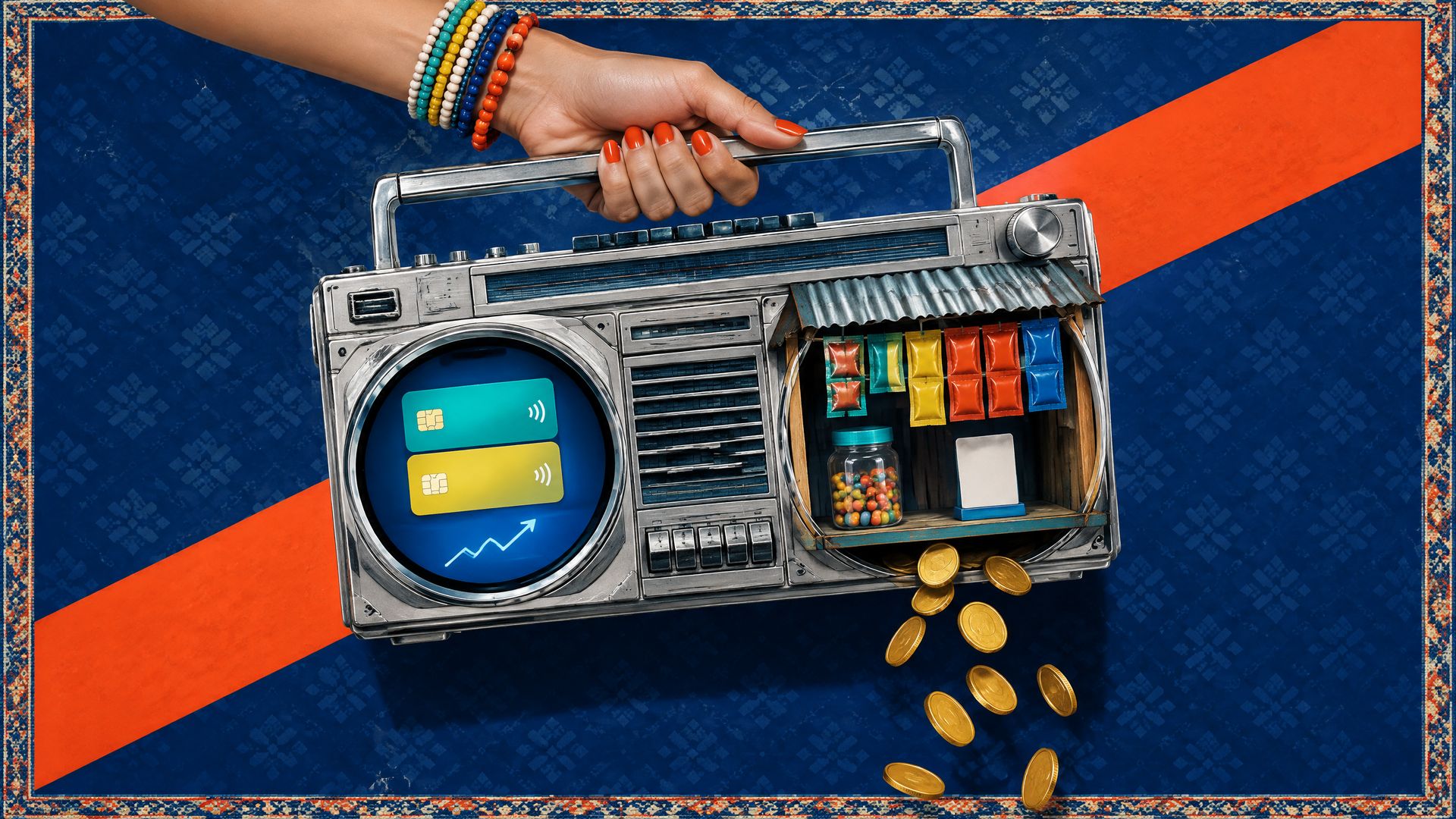
A sari-sari store on a provincial street. A tin roof, a wall of shampoo sachets, a freezer of ice candy, and taped to the glass counter a blue QR code next to a handwritten sign offering cash in and cash out. A tricycle driver pays for his load by phone. A grandmother collects money her son sent from Manila.
The store owner earns a small fee on both. Nobody in this scene thinks of GCash as a fintech brand. They think of it as the way money moves. That is what a mass brand looks like in financial services, and it took GCash about two decades, a regulator’s QR standard, a pandemic and a network of neighbourhood shops to get there.
- What is GCash, and how did a telco SMS service become a national wallet?
- Why did GCash become a mass brand when other wallets stayed niche?
- What role did everyday merchants play in the GCash brand?
- How did a regulator’s QR rule change the GCash brand play?
- Which GCash campaigns are on the record, and who made them?
- Where did the GCash brand stop working?
- What should a regulated Indian brand take from GCash?
- People also ask
What is GCash, and how did a telco SMS service become a national wallet?
GCash is the mobile wallet of the Philippines. It is operated by G-Xchange, Inc. (GXI), which is regulated by the Bangko Sentral ng Pilipinas, the country’s central bank. GXI is a subsidiary of Mynt, which began as a Globe Telecom fintech unit; Ayala Corporation and Ant Financial, the parent of Alipay, invested in it in 2017.
The service began in October 2004 as Globe Telecom’s SMS money transfer product. It was a feature for prepaid phone users, not a finance brand. By GCash’s own twenty-year retrospective, it reached its first one million users within two years. A remittance service followed in 2010 with more than 18,000 outlets. The app arrived in 2012, and GCash describes it as the country’s first e-wallet app.
Today the company says 94 million Filipinos have used GCash, and that it has 6 million merchants and social sellers on the app. Its official about page states the vision in three words: finance for all. The timeline below shows how the brand was built one proof point at a time.
| When | What ran or happened | Who made it | What it changed |
|---|---|---|---|
| October 2004 | GCash launches as an SMS money transfer service | Globe Telecom, through G-Xchange | Money moves on a basic phone, no bank account needed |
| 2010 | GCash Remit launches with more than 18,000 outlets | GCash | A physical network where cash turns digital |
| 2012 | The GCash app launches | GCash | The wallet becomes a screen, not a text message |
| 2017 | Ayala Corporation and Ant Financial invest in Mynt, the Globe Telecom unit behind GCash | Globe Telecom, Ayala Corporation, Ant Financial | Capital and payments know-how behind the brand |
| 2017 | QR payments launch, described by GCash as the first mobile money QR payment in the country | GCash | A sticker on a counter becomes a checkout |
| October 2019 | The central bank adopts a national QR code standard, QR Ph | Bangko Sentral ng Pilipinas | QR payments start moving toward interoperability |
| 2020 | GCash carries the second tranche of pandemic cash aid, about ₱16 billion to over 2.4 million beneficiaries | Department of Social Welfare and Development, with GCash as a provider | First wallet for millions of first-time users |
| June 2022 | Nearly 300,000 community stores onboarded, including 240,000 sari-sari stores | GCash | Every neighbourhood gets a GCash counter |
| May 2023 | Unauthorised transactions hit accounts; the privacy regulator attributes them to phishing | National Privacy Commission finding | Trust becomes the brand’s main job |
| July 2023 | Deadline for full adoption of QR Ph by payment providers | Bangko Sentral ng Pilipinas | One QR code works across banks and wallets |
| January 2024 | Campaign film with actress Heart Evangelista-Escudero | Publicis JimenezBasic | A mass brand borrows aspiration |
| November 2024 | The central bank investigates unauthorised deductions; GCash cites a system error and refunds users | Bangko Sentral ng Pilipinas | A second trust test in eighteen months |
| October 2025 | GSafeTayo anti-scam campaign wins Master of Media at the YouTube Works Awards, Southeast Asia | Agency not named in the report | Safety turned into brand content |
| 2026 | Loan Song Syndrome campaign for GLoan with free health insurance | Universal McCann Philippines and Publicis JimenezBasic | A loan product sold with a song |
Why did GCash become a mass brand when other wallets stayed niche?
Three things did most of the work, and none of them was a tagline.
- Distribution before advertising. GCash started inside a telco with a national prepaid base and a network of outlets where cash could be turned into digital money and back. A wallet is useless if you cannot fill it. GCash solved the fill problem first.
- The store owner as a partner, not a channel. GCash Pera Outlets let sari-sari stores handle cash in, cash out, bill payments and money transfers for their customers. GCash told the press in 2022 that store owners can earn up to ₱10,000 a month this way. The store owner has a reason to push GCash, so the brand is recommended by the most trusted person on the street.
- A national moment with the government. In 2020 the Department of Social Welfare and Development used GCash to disburse the second tranche of its pandemic cash aid. Philstar reported about ₱16 billion going to over 2.4 million beneficiaries, with individual amounts between ₱5,500 and ₱8,000 depending on the area. For many of those people, GCash was the first wallet they ever opened, and it arrived carrying money they needed.
- A promise simple enough to prove. Finance for all is a claim anyone can test. You either can pay the tricycle driver with your phone or you cannot. Each successful payment is a small piece of evidence for the brand.
The Indian parallel is familiar. A payments brand does not win the kirana counter with a film. It wins because the shopkeeper trusts it to settle, the customer can load it easily, and the QR code on the counter works every time. The advertising then names a habit that already exists.
A mass financial brand is a habit first and a logo second.
What role did everyday merchants play in the GCash brand?
Merchants were the brand’s media before GCash bought much media. A QR code taped to a counter is an advertisement seen by every customer, every day, at the moment of payment. No billboard gets that frequency.
SIGNALNewsletter by Yamm Labs
The next piece, straight to your inbox.
New writing on BFSI brands, B2B and influencer marketing, and AI search.
One click to unsubscribe. Privacy policy

In June 2022 GCash reported onboarding nearly 300,000 community stores: 240,000 sari-sari store owners, 20,000 market vendors and 31,000 tricycle drivers. At the same time it reported more than 60 million registered users and 5 million merchants and social sellers. The pattern is deliberate. The brand went to the people who handle the most small cash in any neighbourhood and gave them a reason to go digital.
This also shaped the brand’s look. A payments brand that lives on counters needs a mark that reads on a printed standee under a tube light, on a cracked phone screen and on a sticker that has been in the sun for a year. Simple colour, a short name and a high-contrast QR frame beat a subtle identity every time. We explain the broader principle in what makes a great BFSI brand: in finance, the brand is judged at the point of use, not in the brand book.
How did a regulator’s QR rule change the GCash brand play?
This is the regulator-driven decision most write-ups miss. In October 2019 the Bangko Sentral ng Pilipinas adopted a national QR code standard, QR Ph, built on the EMV QR specification. In 2023 it set 1 July 2023 as the deadline for full adoption by supervised payment providers. The stated aim was to stop merchants and customers having to keep several accounts and display several QR codes.
For a brand that had won the counter with its own QR code, that is a real shift. Once any QR Ph code can be paid from any participating bank or wallet, the sticker on the counter stops being a moat. The brand has to win on what happens after the scan: speed, the confirmation screen, the free transfer, the store owner’s commission and the trust that the money arrives.
The design decision that follows is specific. On an interoperable standee, the network mark and the scheme mark share the space, and the wallet’s own brand moves to the frame, the colour and the confirmation screen the customer sees after paying. The payment receipt becomes the most important brand surface, because it is the one screen that is only yours.
India went through the same shift. UPI, run by NPCI, made QR codes interoperable across apps, so a kirana counter can accept payment from any UPI app. Indian wallet brands learned the same lesson: the logo on the sticker matters less than the habit, the speed and the confirmation that follows.
Which GCash campaigns are on the record, and who made them?
We name agencies only where a published report names them.
- Heart Evangelista-Escudero, January 2024. Adobo Magazine reported a campaign film by Publicis JimenezBasic, launched on 30 January 2024, showing the actress using GCash in daily life, from sending money to paying abroad with the GCash card. The line she closes on ties the brand to her name. The creative logic: a mass brand borrowing aspiration without losing the everyday use cases. No results were published.
- GSafeTayo, recognised October 2025. The campaign won Master of Media at the YouTube Works Awards in both the Philippine and Southeast Asia rounds, and the report says it was the first Philippine brand to win at the Southeast Asia level. The report does not name the agency. It is an anti-scam campaign, which matters after 2023.
- Loan Song Syndrome, 2026. Adobo Magazine credits Universal McCann Philippines and Publicis JimenezBasic. The campaign turned GLoan with free health insurance into an earworm and ran from long hero films down to six-second bumpers. The report attributes to it a 14.5% increase in daily users and a 36.7% increase in daily disbursements. These are the brand’s and the award entry’s figures, not an independent audit.
What is not on the record matters too. We found no published agency credit for GCash’s early SMS-era marketing or for the pandemic-era communication, so we do not name one.
Where did the GCash brand stop working?
Scale made GCash the default, and the default is the first target. In May 2023 users reported unauthorised transactions and GCash took the platform down for maintenance. On 24 May 2023 the National Privacy Commission said its investigation found the losses came from a phishing scheme run through online gambling sites, not a hack of GCash itself.
In November 2024 users again reported unauthorised deductions. Philstar reported that the Bangko Sentral ng Pilipinas opened an investigation into G-Xchange and told it to resolve the cases and complete refunds without delay. GCash attributed the deductions to a system error, said accounts remained secure and said refunds were under way.
Neither incident ended the brand. Both showed the ceiling of a brand built on convenience. When you promise finance for all, you inherit everyone’s risk: the first-time user who clicks a gambling link, the grandmother who shares a code. The response since then has been to make safety part of the brand story, which is where GSafeTayo fits.
For an Indian brand, the takeaway is not that incidents can be avoided. It is that the safety language should already exist, tested and approved, before the first incident. Writing it in the week of a crisis, under a regulator’s notice, is too late.
What should a regulated Indian brand take from GCash?
The GCash story is about distribution and trust, but every lesson has a compliance edge in India.
- Put the legal entity in the lockup from day one. GCash’s official pages carry a line naming G-Xchange, Inc. as regulated by the Bangko Sentral ng Pilipinas. In India, IRDAI’s 2024 policyholder protection regulations require an insurer’s advertisement to show its registered name with its trade name or logo prominently, and ads issued by distribution channels need the insurer’s written approval before they go out. Design the registered-name line into the end-card and footer templates, fixed size and fixed position, so no agency or partner can drop it.
- Plan the screen sequence, not just the ad. A loan campaign like Loan Song Syndrome ends in an app. In India, the RBI’s Key Facts Statement must be given to the borrower before the loan contract is executed for retail and MSME term loans sanctioned from 1 October 2024, and it includes the annual percentage rate. The ad, the landing screen and the Key Facts Statement screen are one journey. Brand them as one.
- Budget time for the fixed elements in video. If the product is a mutual fund, SEBI requires the standard warning in audio-visual ads to be displayed and voiced for five seconds. A six-second bumper cannot carry that and a message. Pick formats that fit the rule before you buy the media.
- Make the counter the hero. Brands we work with in insurance, banking and wealth, including HDFC Life, Axis Bank and Paytm Money, all sell through someone: an agent, a branch, a distributor, an app screen. Design for that person’s hands first.
- Write the safety language before you need it. Keep a pre-approved set of anti-fraud messages, in every language you serve, ready for the day something goes wrong.
If you are also thinking about how AI answer engines describe your brand, our GEO and AEO FAQ for financial brands covers what makes a page quotable.
People also ask
Who owns GCash?
GCash is operated by G-Xchange, Inc., a subsidiary of Mynt. Mynt began as a Globe Telecom fintech unit, and Ayala Corporation and Ant Financial invested in it in 2017. G-Xchange is regulated by the Bangko Sentral ng Pilipinas.
When did GCash start?
GCash launched in October 2004 as Globe Telecom’s SMS money transfer service. The app followed in 2012, and QR payments in 2017.
Why did GCash grow so fast during the pandemic?
The Department of Social Welfare and Development used GCash to disburse the second tranche of its pandemic cash aid in 2020, about ₱16 billion to over 2.4 million beneficiaries. Many recipients opened their first wallet to receive it, and then kept using it at local stores.
Which agency makes GCash’s advertising?
Published reports credit Publicis JimenezBasic for a January 2024 campaign film, and Universal McCann Philippines with Publicis JimenezBasic for the 2026 Loan Song Syndrome campaign. Reports we found do not name an agency for other campaigns.
Is your brand trusted at the counter, or only in the commercial?
Get a free Fintech Brand Audit across 8 dimensions, plus 3 fixes. No pitch. Run the free Brand Audit →