

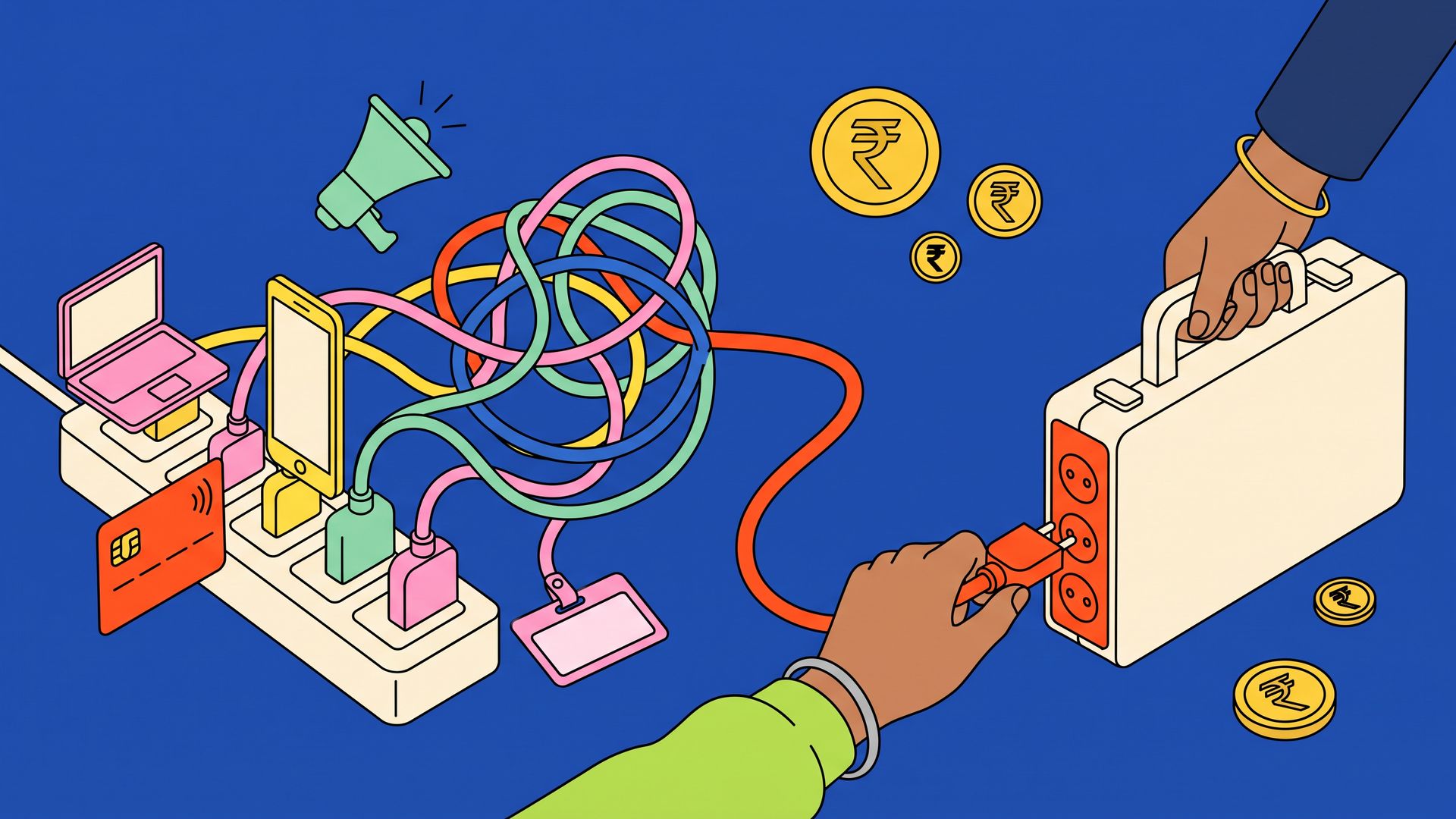
Picture a vendor review at a mid-size D2C company in Pune. The founder picked Razorpay years ago because an engineer had the checkout live in an afternoon. Now the CFO is on the call, and the questions have changed. Is the current account held with a bank? Who is the regulated entity on the payout contract?
Can payroll and vendor payments run from the same dashboard as collections? The engineer’s reasons for choosing the brand still matter, but they no longer decide the renewal. That shift, from a brand chosen by developers to a brand renewed by founders and finance heads, is the story of how Razorpay’s messaging grew up, and it is a problem many Indian B2B fintech brands meet as they grow.
- Who is Razorpay and where did the brand start?
- Why did a developer-first payments brand have to change its message?
- What did Razorpay change in its brand and messaging?
- Which regulator-driven design decisions does the Razorpay site show?
- What result did the messaging shift produce?
- What should an Indian BFSI or fintech brand learn from Razorpay?
- How would we brief a developer-to-CFO repositioning today?
- People also ask
Who is Razorpay and where did the brand start?
Razorpay was founded in 2014 by Harshil Mathur and Shashank Kumar, and went through Y Combinator’s Winter 2015 batch, according to Y Combinator’s own company page. Razorpay’s About page says the founders are IIT Roorkee alumni and describes the company’s original purpose in developer terms: making online payments frictionless through clean, developer-friendly APIs.
That origin shaped the first brand. A payment gateway in India at the time tended to be chosen by whoever had to integrate it, and that person was usually a developer. The proof a developer wants is documentation, SDKs, sandbox keys and a checkout that does not break. So the brand led with the product surface a developer touches: the API reference, the docs, the speed of going live. The current homepage still carries that line in its developer section, which says Razorpay is built for developers by developers, and the About page still lists documentation, SDKs, an API reference and an API playground among what the company offers.
The situation, in business-school terms, is simple. A two-founder Indian payments startup, selling one product to one reader, with a brand built for that reader. The complication came from growth.
SIGNALNewsletter by Yamm Labs
The next piece, straight to your inbox.
New writing on BFSI brands, B2B and influencer marketing, and AI search.
One click to unsubscribe. Privacy policy

Why did a developer-first payments brand have to change its message?
Three forces changed who reads a Razorpay page, and all three are common among Indian B2B fintechs that survive their early years.
- The product line grew past payments. The About page today lists payment products such as the gateway, payment links, payment pages, QR codes, UPI and subscriptions, and beside them business banking under RazorpayX, payroll, digital lending and point-of-sale systems. Each new line has a different buyer. Payroll is bought by HR and finance. A current account and corporate cards are bought by the founder and the CFO. Credit is signed off by whoever carries the balance sheet.
- The regulator arrived in the product. In March 2020 the RBI issued its guidelines on the regulation of payment aggregators and payment gateways, updated in November 2020. Non-bank payment aggregators now needed RBI authorisation under the Payment and Settlement Systems Act, 2007. Existing players had to apply on or before 30 June 2021 and meet net-worth thresholds of ₹15 crore by 31 March 2021 and ₹25 crore by 31 March 2023. After 2020, a CFO evaluating a payments partner has good reason to ask about authorisation before asking about APIs.
- The buyer became a committee. A developer can still pick the gateway, but a renewal, a banking relationship or a payroll migration passes through finance, legal and sometimes the board. Each of them reads the website before the sales call, and each looks for a different kind of proof.
The complication, then, was a brand whose voice was right for one reader and incomplete for the three readers who now signed the cheque. A brand that only speaks API sounds small to a CFO. A brand that drops the API voice loses the engineers who still start most evaluations.
What did Razorpay change in its brand and messaging?
We can only describe what Razorpay’s own public pages show today. Razorpay has not published a before-and-after brand document that we could find, and we have not seen internal briefs, so the decisions below are read from the result on the site, not from the company’s reasoning.
- A master-brand promise written for the business. The homepage headline now presents Razorpay as India’s all-in-one finance platform, and its subheadline lists the jobs: accept payments, make payouts, manage banking, automate payroll and access credit. Y Combinator’s company page carries the same idea in a different line, calling Razorpay a full-stack financial solutions company for businesses. Neither line mentions APIs. Both are written for the person who owns the finance function.
- Navigation grouped by the job, not the product code. The product menu is organised as Accept Payments, Make Payouts, Business Banking, Automate Payroll and Get Credit and Loans, plus a group for AI-native products. A CFO scans verbs. A developer scans product names. Grouping by verb serves the CFO first and still lets the developer find the gateway.
- Sub-brands where the buyer changes. Payouts, business banking and payroll sit under RazorpayX and RazorpayX Payroll. The sub-brand tells a reader that this is a different kind of product with a different contract, without breaking away from the parent name that carries the trust.
- Proof written in finance language. The RazorpayX page says it is trusted by 70% of India’s unicorns, cites a 99.9% success rate on real-time payment routing, bulk payouts of up to 50,000 with a single OTP, and $10 billion of total payout volume processed in 2024. The About page says more than 50 lakh businesses use Razorpay for payments. These are company claims, but look at their form: scale, reliability and control, the three things a finance head is paid to worry about.
- The developer promise kept, one layer down. The line about being built for developers by developers lives in its own section, next to SDKs, REST APIs and webhooks. Today it sits in a section rather than the headline, which is the right place for a reader who will scroll to find it anyway.
| Brand layer | What a developer reader needs | What a founder or CFO reader needs | What Razorpay’s current site shows |
|---|---|---|---|
| Headline promise | Easy integration, uptime | One platform for money in, money out and credit | All-in-one finance platform; the jobs listed in the subheadline |
| Navigation | Product names, docs, API reference | Tasks: collect, pay, bank, run payroll, borrow | Menu grouped by task; docs and SDKs in a developer section |
| Proof | Documentation quality, SDKs, sandbox | Scale, success rates, peer adoption | Business counts, unicorn adoption share, payout volume, success rate, all stated by the company |
| Brand architecture | One product name to integrate | Clarity on which entity signs which contract | Razorpay master brand; RazorpayX and RazorpayX Payroll as sub-brands |
| Regulatory lines | Rarely read | Read first: authorisation, banking partner, lending entity | Payment aggregator entity named; RazorpayX not-a-bank statement; partner banks named; lending under a separate entity |
Which regulator-driven design decisions does the Razorpay site show?
This is the part most agency case studies skip. Calling a brand compliance-aware says nothing. The useful question is which lines the regulator put on the page, and where the brand chose to place them. Razorpay’s current pages show three such decisions clearly.
First, naming the regulated entity under the master brand. The homepage states that Razorpay Payments Private Limited is an RBI Authorised Payment Aggregator. The About page adds that digital lending is run by a separate entity authorised by the RBI as a Lending Service Provider. A founder sees one brand. A CFO or a legal reviewer sees which company holds which authorisation. The brand decision is to let the master brand carry the relationship while the legal entity carries the licence, and to write both down where a reviewer will look.
Second, the not-a-bank line on a page that sells business banking. RazorpayX is marketed as an all-in-one business banking suite. That is a strong word to use when you are not a bank. The page answers it directly: the RazorpayX powered current account and the Visa corporate credit card are provided by RBI-licensed banks, and RazorpayX itself is not a bank and does not hold or claim to hold a banking licence.
It names the partner banks, ICICI, RBL and Yes Bank. The design decision is to let the headline promise banking as a job while the disclosure makes clear who holds the deposit. Brands that bury that line in the terms page tend to find it again in a customer complaint or a supervisory question.
Third, grievance and policy information where a customer can find it. The RBI’s current rules for payment aggregators, consolidated in a September 2025 master direction, ask aggregators to disclose merchant policies, privacy policy and other terms on their website or app, and to display the details of their grievance officer and escalation matrix prominently on their website. For a brand team this is a layout rule, not a legal footnote. It decides what goes in the footer, what the help centre is called, and how many clicks a customer needs to reach a named grievance contact. The full text is on the RBI’s page for the master direction on payment aggregators, which replaced the 2020 guidelines.
A fourth decision is waiting for any B2B fintech that sells credit under its brand, and it is worth planning before launch. For retail and MSME term loans sanctioned from 1 October 2024, the RBI requires lenders to give the borrower a Key Facts Statement, including the annual percentage rate, before the loan contract is executed. A brand that promises instant credit has to design a screen sequence where that statement is shown and read before the accept button, not after it. That is a product decision with the brand’s name on it.
A developer picks the payment gateway; a CFO decides whether it stays, and the brand has to be written for both.
What result did the messaging shift produce?
The fair answer is that the business result of the messaging change is not publicly reported. Razorpay’s pages state scale: more than 50 lakh businesses on its payments products, a share of India’s unicorns on RazorpayX, and a payout volume figure for 2024. None of these numbers is tied by the company to a specific brand or messaging decision, and we have not found an independent study that separates brand effect from product, pricing and sales effort.
What can be observed is the shape of the brand today. The master name now carries payments, banking, payroll and credit. The headline speaks to a business owner. The proof speaks to a finance head. The developer section still exists. The regulated entities are named on the page. That is a finished answer to the question every developer-first fintech eventually faces: how do we sound like a finance partner without sounding like we forgot where we came from?
Anyone who tells you this messaging shift produced a specific percentage of growth is guessing. The real lesson is structural, and it holds whether your company is Razorpay’s size or a tenth of it.
What should an Indian BFSI or fintech brand learn from Razorpay?
- Write the headline for the person who renews, and the second section for the person who integrates. The developer still starts the evaluation. The founder and the CFO finish it. Order the page so each finds their proof without hunting.
- Group products by the job a finance team does. Collect, pay, bank, run payroll, borrow. Product names mean something to your team; verbs mean something to the buyer.
- Use sub-brands where the contract changes. A sub-brand is a signal that a reader is moving into a different product with a different regulated partner. Keep it tied to the parent so the trust carries over. Our guide to brand guidelines for fintech startups covers how to write those rules down so a new product team does not invent its own.
- Put the regulated entity and the not-a-bank line on the page, not in the terms. If you sell banking through partners, say so where the word banking appears. If a different company holds the payment aggregator authorisation or runs lending, name it. A legal reviewer at your customer’s company will look for it, and finding it quickly builds more trust than any adjective.
- Give finance-grade proof, and label it as yours. Success rates, volumes and adoption figures work for a CFO when they are stated as company claims with a date. Invented or unattributed numbers do the opposite.
- Do not let the identity carry the whole change. Many teams reach for a new logo when the real problem is page order and proof. Before you brief a redesign, read our list of fintech logo design mistakes; several of them come from asking the mark to do the messaging’s job.
For a bank, insurer or fund working with a fintech partner, the same test applies in reverse. Ask the partner which entity holds which licence, where that is stated on their site, and how their brand separates what they do from what the regulated partner does. A partner that can answer in one screen is easier to put in front of your own compliance team.
How would we brief a developer-to-CFO repositioning today?
If a payments or lending brand asked us to make the same move, the brief would start with the reader map, not the moodboard. List every reader who touches the purchase, from the engineer running the sandbox to the CFO signing the renewal. For each one, write the single proof they need and the page where they will look for it.
Then map the regulated entities. Every product, the licence behind it, the partner bank or lender, and the disclosure line that has to appear where the product is sold. This map decides the brand architecture more than any naming workshop, because a sub-brand that crosses two regulated entities will confuse a legal reviewer however good the name is.
Only then write the headline, the navigation and the proof blocks, and only after that touch the identity. A brand that grew up the way Razorpay’s did usually keeps its name and its mark and changes almost everything around them. You can see how we approach that sequence on our work page.
People also ask
When was Razorpay founded and who founded it?
Razorpay was founded in 2014 by Harshil Mathur and Shashank Kumar, according to Y Combinator’s company page, and went through Y Combinator’s Winter 2015 batch. Razorpay’s About page describes the founders as IIT Roorkee alumni.
Is RazorpayX a bank?
No. RazorpayX’s own page states that it is not a bank and does not hold a banking licence. The current account and corporate credit card it offers are provided by RBI-licensed partner banks, which the page names as ICICI, RBL and Yes Bank.
How does Razorpay speak to CFOs rather than only developers?
Its homepage leads with a business promise, an all-in-one finance platform, and groups products by task: accept payments, make payouts, business banking, payroll and credit. Proof is given in finance terms such as payout volume and success rates, while the developer message sits in its own section with docs, SDKs and APIs.
What regulator lines should a B2B fintech brand show on its website?
At minimum, the legal entity that holds each RBI authorisation, a clear statement of which partner bank or lender provides any banking or credit product, and easy-to-find grievance and policy information. The RBI’s rules for payment aggregators ask them to disclose merchant policies and other terms on their website or app, and to display grievance officer and escalation details prominently.
Is your fintech brand still written only for the developer who integrated it?
Get a free Fintech Brand Audit across 8 dimensions, plus 3 fixes. No pitch. Run the free Brand Audit →